Choose Planters That Earn Their Place
The single fastest way to make a compact patio or balcony look calm and expansive is to replace twelve small, mismatched round pots with three continuous rectangular troughs tucked flush against the perimeter. Round pots leave awkward triangular dead gaps behind them that trap fallen leaves and push the front rim into your walkway. Straight-sided slimline troughs hug walls cleanly and hold far more continuous soil volume per centimeter of floor intrusion.
MAP MY SMALL SPACE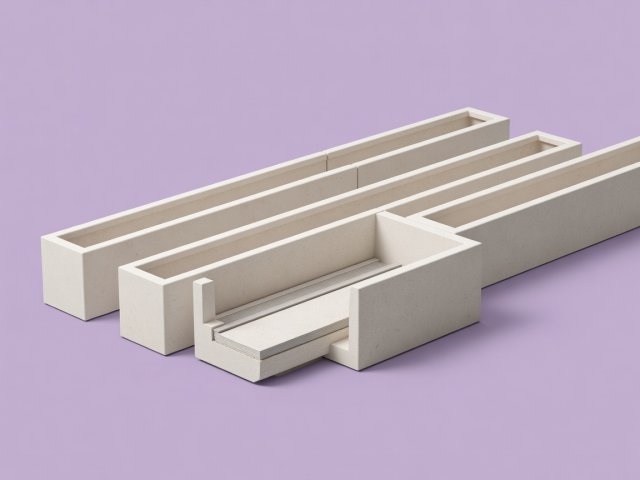
Why Fewer, Larger Troughs Outperform Small Pots
In a pot smaller than 250mm in diameter, ambient air heats the root zone rapidly on sunny afternoons and freezes it solid in winter. Furthermore, a collection of small pots creates visual noise at ankle height, drawing attention to the cramped floor dimension.
-
Continuous Root Runs: A 1200mm × 300mm × 450mm trough provides 162 liters of shared soil volume, allowing a structural shrub, mid-layer grasses, and trailing groundcover to share moisture reserves.
-
Concealed Riser Feet (15mm Clearance): Elevating flat-bottomed troughs on invisible 15mm rubber pads prevents ring-staining on porous sandstone or timber decking and stops roots blocking drainage holes.
-
Lockable Castor Caddies for Utility Access: If a planter must sit over a manhole cover or beside a meter cupboard, specify a recessed steel base plate with four heavy-duty 150kg polyurethane swivel castors hidden behind a 40mm skirt.
Balcony-to-Backyard Weight Engineering
Whether you are furnishing an upper-floor balcony (commonly designed to Eurocode EN 1991-1-1 residential imposed load allowances of 1.5 to 2.5 kN/m², or roughly 150–250 kg/m²) or lifting planters up narrow townhouse stairs, container shell weight and wet substrate density matter enormously.
Lightweight Substrate Formula (Saves ~35% Weight vs. Topsoil):
-
Peat-free composted bark and coir fiber base for moisture retention and low dry bulk density.
-
Expanded clay aggregate pebbles (LECA, 4mm–10mm grade) or horticultural pumice to maintain permanent air-filled porosity without heavy quartz sand.
-
Composted green-roof substrate or fine worm castings plus slow-release 9-month controlled-release fertilizer prills.
Material & Root-Depth Specification Table
Match your planter material and internal soil depth to the mature root architecture of your chosen plants:
| Container Material | Empty Shell Weight (1000×300×450mm) | Frost & UV Durability | Wall Thickness Lost | Recommended Lining & Care |
|---|---|---|---|---|
| Powder-Coated Marine Aluminium (2mm–3mm) | 11 – 14 kg | Excellent (No cracking to -25°C) | 3mm per side (Max soil space) | Line inner walls with 20mm XPS foam board to insulate roots from summer sun heat |
| Fiberstone / GRC (Glass Reinforced Concrete) | 24 – 32 kg | High (Breathable matte mineral finish) | 12mm – 18mm per side | Keep drainage holes clear with stainless mesh; raise 15mm off paving |
| Western Red Cedar / Thermowood Trough | 18 – 22 kg | Excellent natural thermal insulation | 22mm – 35mm per side | Line interior with dimpled HDPE drainage membrane (nubs facing wood for airflow) |
| Rotationally Molded Linear Polyethylene | 7 – 10 kg | High (Impact proof, zero moisture absorption) | 6mm – 10mm per side | Ideal for weight-restricted balconies and narrow side returns |
Minimum Root Depth by Plant Group
Based on RHS container cultivation guidelines, never compromise on vertical soil depth even when narrowing front-to-back trough width:
150mm – 200mm Depth: Succulents (Sempervivum, Sedum), creeping thyme, winter violas, and shallow salad cut-and-come-again leaves.
250mm – 350mm Depth: Herbaceous perennials (Geranium 'Rozanne', Heuchera), compact ornamental grasses, strawberries, and bush tomatoes.
450mm – 600mm Depth: Multi-stem specimen shrubs, small trees (Acer palmatum, olive, dwarf apple), climbing roses, and clumping bamboo.
Sub-Irrigation (Self-Watering) Reservoirs
Installing a 60mm false floor reservoir with capillary wicking columns at the bottom of a 450mm-deep trough stores 18 to 25 liters of water below the root zone, coupled with an overflow spout drilled just beneath the separator plate so winter rain never drowns the roots.
Next: Privacy & Lighting