Take Your Growing Space Upward
A typical 4-meter-square courtyard has only 16 square meters of floor, yet its three surrounding 2-meter-high boundary walls provide 24 square meters of vertical plane. When you shift foliage from the floor onto engineered wall grids, tiered trough racks, and espalier wires, you keep the ground clear for furniture and foot traffic while wrapping the garden in deep botanical texture.
Successful vertical planting relies on two non-negotiable details: protecting the structural wall behind the plants with an air gap, and preventing upper tiers from drying out while lower tiers waterlog.
MAP MY SMALL SPACE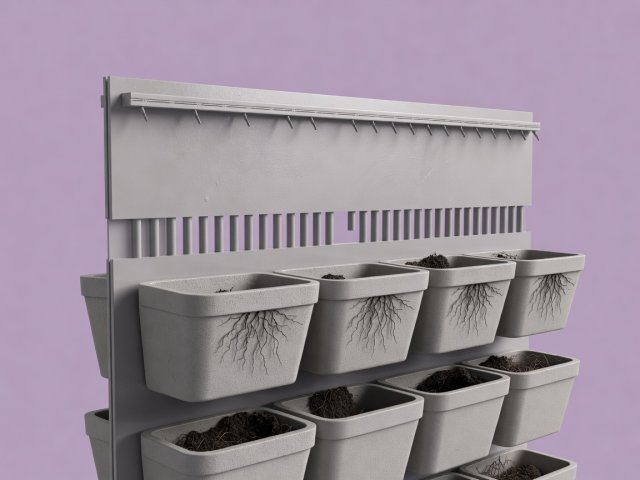
Ground-Rooted Climbers vs. Living Wall Modules
Botanist Patrick Blanc pioneered hydroponic felt living walls on museum facades, but for domestic gardeners without commercial pump rooms, simpler soil-based or ground-rooted systems are far easier to keep thriving over a decade.
-
Ground-Rooted Wire Grids (Lowest Maintenance): Plants grow in the ground or a deep 450mm base trough and climb stainless steel cables. Because roots sit in cool, large-volume soil at the base, watering only needs to happen at ground level.
-
Interlocking Reservoir Troughs (Moderate Maintenance): Stacked polypropylene troughs hold 6–10 liters of compost per row with an internal 20mm water weir that cascades excess water from the top rail down to lower tiers.
-
Breathable Felt Pockets (Seasonal / Culinary): Best for shallow-rooted herbs, alpine strawberries, and annuals; requires daily summer irrigation via a battery tap timer.
Protecting Brick & Timber Boundaries
Never screw saturated soil pockets directly onto a neighbor's timber fence panel or an unrendered party wall. Wet compost held against timber causes fungal rot within 18 months, and saturated weight can bow lightweight lap-fence posts during winter gales.
Fix vertical recycled-plastic or pressure-treated UC4 battens using M8 stainless steel sleeve anchors, attach a 6mm twin-wall polycarbonate or HDPE damp sheet, and hang troughs onto the rails.
Alongside lightweight boundary fences, sink two 75mm × 75mm galvanized steel or oak posts 600mm into concrete footings 100mm inside your own boundary to carry the entire vertical load independently.
Vertical System Comparison & Structural Loads
Use the figures below to match your wall's load-bearing capacity and sunlight exposure with the right vertical hardware and plant palette.
| Vertical System | Depth Projection from Wall | Saturated Weight per m² | Recommended Wall Stand-Off | Proven Small-Space Species |
|---|---|---|---|---|
| 316 Stainless Steel Wire Trellis | 50mm – 80mm | 8 – 15 kg/m² | 40mm cylindrical hub | Trachelospermum jasminoides, Clematis armandii 'Apple Blossom' |
| Modular Reservoir Trough Cassettes | 180mm – 220mm | 45 – 65 kg/m² | 30mm batten + backing sheet | Polystichum setiferum, Heuchera 'Obsidian', Carex oshimensis |
| Horizontal Espalier Wire Tiers | 150mm – 250mm | 12 – 20 kg/m² (root in ground) | 50mm eye-bolts | Apple 'Discovery' (M26), Pear 'Concorde' (Quince C), Fig 'Brown Turkey' |
| Non-Woven Geotextile Pocket Panel | 140mm – 160mm | 28 – 38 kg/m² | 25mm air-gap batten + waterproof membrane | Thyme, Oregano, Trailing Rosemary, Fragaria vesca (Alpine strawberry) |
Gravity-Aware Plant Placement
Even with automated drip irrigation, water drains downward under gravity and wind speed is higher at the top of a two-meter wall. Organize your vertical planting in three microclimate bands:
Top Tier (1.4m – 2.0m High): Drought-tolerant, sun- and wind-resilient evergreens such as prostrate rosemary, Sedum, thyme, and Festuca glauca.
Middle Tier (0.7m – 1.4m High): Medium-moisture foliage plants at eye level where leaf pattern shines—Heuchera, Tiarella, compact Hakonechloa macra, and dwarf hostas.
Base Tier (0.1m – 0.7m High): Moisture-loving, shade-tolerant species such as hart's-tongue fern (Asplenium scolopendrium), Soleirolia soleirolii, and Ajuga reptans.
Simple Drip Irrigation Setup
Hand-watering a vertical wall with a hose washes soil out of upper pockets. Instead, run a 13mm black poly supply tube discreetly up the corner downpipe and tee into 4mm micro-drip line with pressure-compensating 2-liter-per-hour emitters spaced every 200mm along the top trough.
Set a digital tap timer to run for 6 minutes at 06:00 AM daily from May through September, and 4 minutes twice a week in spring and autumn.
Next: Space-Saving Planters